In Praise of Mess
How I learned to stop worrying and love the chaos. On building AI that adapts to human messiness instead of demanding we be tidier.
For as long as I can remember, my thoughts have moved faster than my hands could catch them. And boy did I want to catch them. Grasping at them all, convinced that any one of them might hold the secret to happiness, wealth, and eternal youth. They'd arrive uninvited, in the quiet moments of in-between: in the shower, on a run, mid-conversation, or during that long, liminal haze right before falling asleep. All too often, I'd force myself out of bed, out of the darkness to the searing screen of my notes app, convinced that this was the one. Afraid to let it go into that good night.
In notes app after notes app, on scattered pieces of paper, in margins of books I'd never finish, they'd pile up. Fragments of entire universes hoarded across my digital and physical space, scattered like breadcrumbs I never quite find my way back to. Swept underneath the bed to be forgotten.
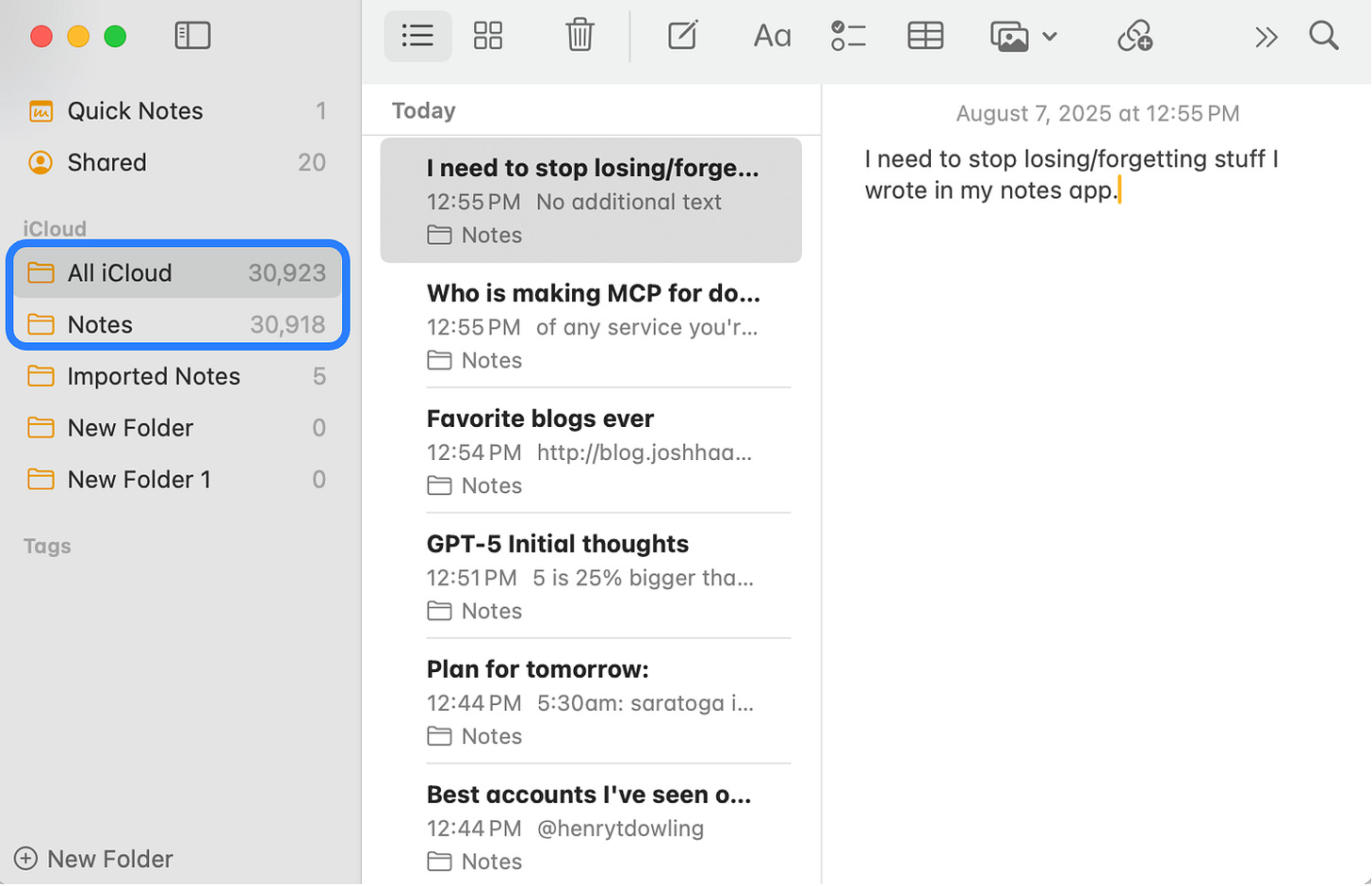
Most note-taking tools are built by people who never seem to forget. They're built for clarity but only because those who use it already have it. It's for people with their folders color-coded, their calendars obedient, their notes neatly organized. It's for people with "OCD" rather than "ADHD". I've tried every productivity system and note taking tool out there from Evernote to Obsidian to the more obscure Zettelkasten. Each one promised to bring order to chaos. Each one collapsed under the constant upkeep required to keep them usable. Every few months I'll declare bankruptcy on my notes. Start afresh on a new page, new notebook, new note taking app, with the weary optimism that this time will be better. Eventually, I stopped trying. Notes and reading lists pile up with the distant hope that eventually, maybe, AI will bail me out.
Building the Lifeline
It seems AI might just bail me out — though in this case, I'm the one building the lifeline. The only way I've found to keep pace with my own brain is to create a tool that can run alongside it, catching what falls through the cracks. It lets me be my chaotic self without the quiet shame of disorganization. While my thoughts dart from one thing to the next, it quietly sorts them in the background.
The promise of technology has always been that it would free us from tedious, repetitive work. Instead, most software has only layered on more clicks, more forms, and more robotic bureaucracy. It hasn't liberated us; it's just made the filing cabinets digital. Minimalism hasn't freed us from hoarding. It has just been rebranded. Your desk may look spotless but there are skeletons hidden under your desktop.
AI finally gives us a way out, not by demanding we be tidier, but by embracing the messiness. We're building something that knows your thoughts don't arrive pre-labeled or neatly color-coded, and doesn't expect them to. In that respect, we're making a different promise: no neat, unchanging folders because let's be honest, they'd be outdated in a week. We are cashing in on the original promise. Not by making you work for the tool, but by having the tool work for you.
The Bigger Picture
As a society, we're living through an on-going experiment — a moment where the rules are still being written, and the boundaries of what's possible shift by the month. We're still figuring out how to channel this technology into something that feels genuinely useful. One thing is clear: cramming chatbots into every product isn't the answer. Instead, we picture a tool that takes in your notes as they are, quietly sorting them in the background so you never waste energy deciding where they belong. One that brings back forgotten sparks of insight at the very moment they matter. One that spots the patterns you'd never notice on your own — and reveals them in ways that catch you off guard.
In the long run, note-taking is just the entry point. Cheap digital cameras and iPhones didn't just make photography more accessible; they transformed how we remember our lives. Suddenly, moments that would have faded into distant memory could be captured, shared, and saved for prosperity. The act of remembering changed and with it, the very act of living. We believe AI will have a similar shift, not just in how we remember the world, but in how we remember ourselves.
Right now, memory is the single biggest limitation of AI. Most tools still require you to start every interaction by re-explaining the entire context, like a goldfish introducing itself every time it swims past you. In five years, people will look back and find it absurd that we ever had to do this.
What holds AI back today isn't raw intelligence. Indeed, reasoning models seem to have largely solved that part of the equation. What holds AI back is the lack of contextual understanding, focus, and planning. These are the ingredients that turn a model from a parlor trick into a true collaborator. Our work starts with helping people make sense of their own notes, but that's just the first chapter in building systems that can remember with you, think with you, and help you act without friction.
The Mission
At the end of the day, our mission is simple: to empower humanity to live more fully and take more agency. Unlike photography, which has pulled us deeper into our screens, we hope AI can push us back into the real world — less distracted, less performative, more present. Memory is the foundation. The rest is what becomes possible once you have it.
Originally published on Sam's Substack.
Ready to get started?
Download Stash Desktop and start automating your workflow today